

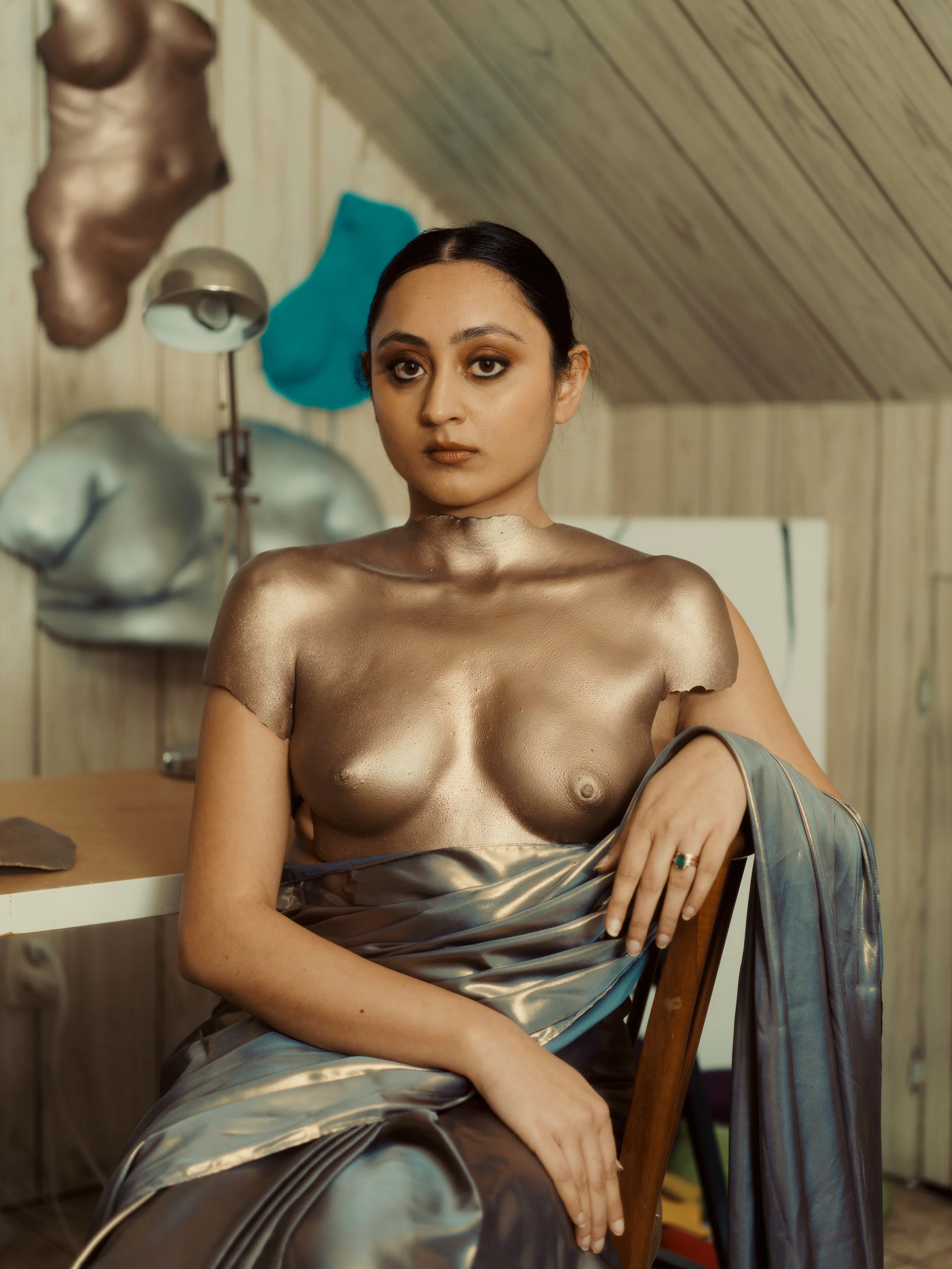
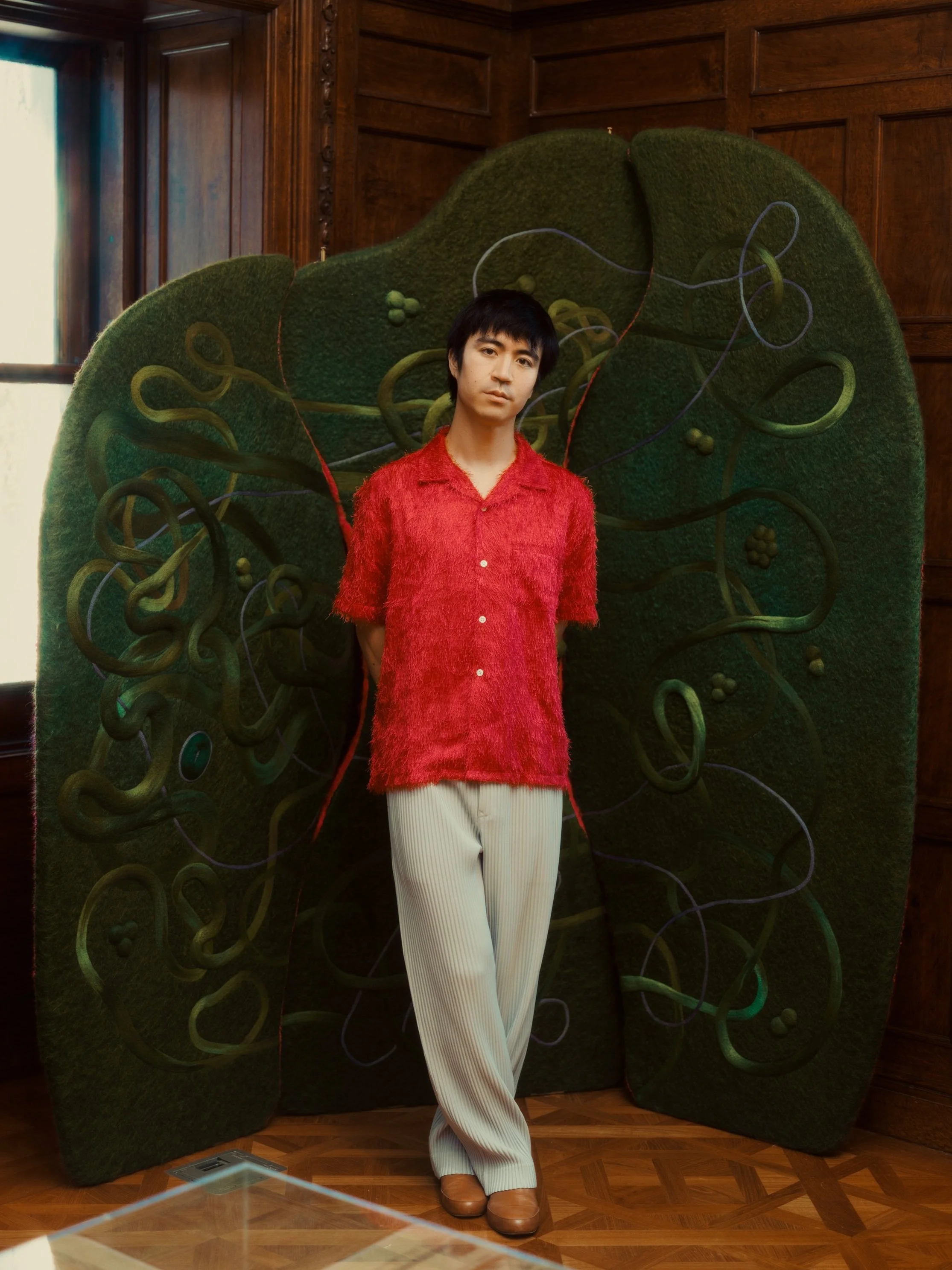
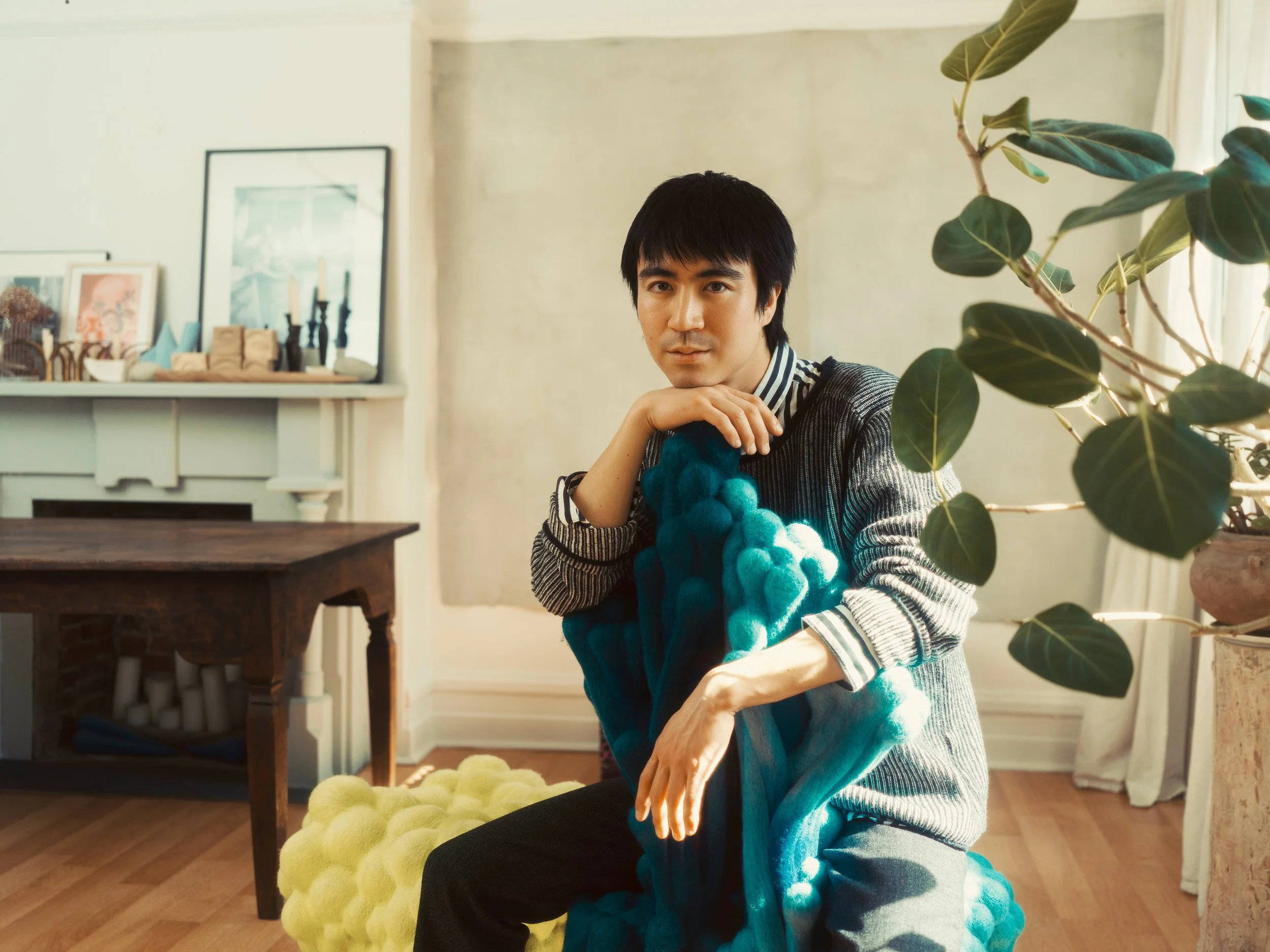
Yvonne Wells is a former schoolteacher, quilter, and folk artist based in Tuscaloosa, Alabama. Born and raised in New York, Liam Lee is an artist and furniture designer who works primarily in merino wool. Pakistani fashion designer and artist Misha Japanwala molds the body to create casts worn as sculptural garments. We brought them together to chat about the overlaps in their work, from craft and technique to a shared reach for radical connection.
FULL LOOK Misha’s Own

HEATHER SAMPLES: I thought we’d start by talking about touch. The work each of you makes really begs to be touched. I’m wondering what you hope will happen when someone touches it.
YVONNE WELLS: When it’s touched, you will know, to me, what it means. If I pick up a piece of broadcloth or a cornmeal sack, that to me means harshness, or being without. They touch it and they feel it and they say, “I can identify with this quilt because of how it feels.” It’s talking to them just like it was talking to me when I made it.
LIAM LEE: For all of us or for anyone who makes things with our hands, and in particular, making functional objects, whether worn on the body or interacted with in the home, we all have a very intimate relationship with the materiality of an object. We’re all very craft focused, and as craftspeople who really engage with the material, we have to know what something feels like.
MISHA JAPANWALA: That intimacy is so important, not just for the process but for the narrative of my work. The main thing my work addresses is this idea of shame and shamelessness, and I think the antidote to shame is care and understanding of one’s body. Touch is one of the ways in which we understand not just other bodies but our own bodies.
FULL LOOK Liam’s Own, LOCATION Cooper Hewitt,
Smithsonian Design Museum
FULL LOOK Liam’s Own
HS: One step further in that connection between you and the viewer would be using the art object. What do you think would be lost if people never used your work?
YW: I think the whole art piece itself would be lost. If they never used my quilts, they would never get a chance to see what I was thinking, what I was using, what my idea was. If you don’t ever get a chance to use my work or any artist’s work, what good is it to do? Only self-satisfaction, probably.

FULL LOOK Yvonne’s Own

FULL LOOK Yvonne’s Own
MJ: I love the idea of leaving it open to the person who’s having their body molded to do whatever they want with it. I held an open call of nipple moldings a couple years ago in New York City. Some people wanted to have it up on the wall, someone turned it into a necklace, someone wanted to use it as a paperweight on their desk. Creating this relationship to that part of the body can only happen if you’re constantly interacting with, or seeing, or existing alongside the work. For the quilt and for the furniture—to exist with this piece, to live with it, is what is so special about these practices.
LL: I think you’re getting at a larger question of the distinction between art and craft, and whether these boundaries really matter, or how evaluation of work shifts when functionality is added. It would probably bum me out if nobody sat in the furniture. But it also can do, as Misha was saying, its own thing just by being in the space with you.

FULL LOOK Misha’s Own

FULL LOOK Misha’s Own
HS: Looking at your work, I find myself thinking about home—a place to be nude, to be under a quilt. A place for soft furniture that cannot survive outside. But you’re all also troubling the idea of home as private. You’re encouraging us to think about home as something that can only exist within a relationship to the world outside. What does home mean to each of you?
MJ: I have two homes that are now separated by thousands of miles. I live between two continents. The idea of home feels very complicated to me most of the time. Having this conversation is a nice reminder of the intimacy of home, how one carries it with themselves everywhere they go—a reminder to think of home as the body.

FULL LOOK Liam’s Own

FULL LOOK Liam’s Own, LOCATION Cooper Hewitt, Smithsonian Design Museum
LL: It’s interesting, Misha, when you mention thinking of home as the body. When the pandemic hit, when I lost my job and we were all stuck in our homes, I had been thinking a lot about how the space of the home maps onto the body. Our bodies became these spaces of safety and refuge, but also anxiety and danger. We realized you can’t really control what comes in and out. So how do we bring in the outside world, make a dream space, a space that feels expansive?
YW: Home means a place of solitude, a place of doing what you want to without outside voices. Home is a place that you and you alone know. But home is also a place where people can come see the person who owns this place, and get something that will take them into the world. ❤

FULL LOOK Yvonne’s Own
STORY CREDITS
PHOTOGRAPHY & STYLING Braylen Dion, WORDS Heather Samples, HAIR & MAKEUP FOR MISHA Melissa Drouillard,
PRODUCER Masha Spaic, CASTING DIRECTOR Muzam Agha
Read more stories


